

As a local Mortgage Agent in Burlington, Ontario, the most common question I hear from homebuyers and real estate partners is: “How much house can I actually afford right now?”
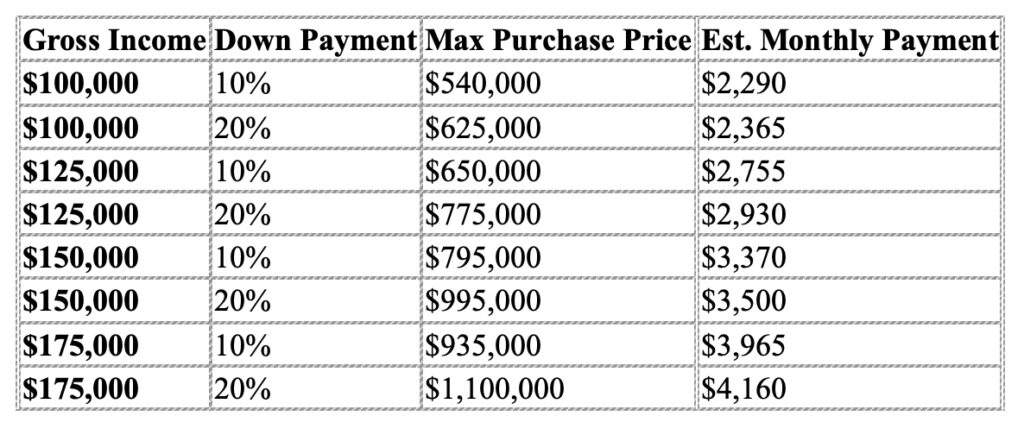
Having a quick benchmark saves time and sets realistic expectations for the Ontario real estate market. Below is a 2026 reference guide mapping gross household income to your mortgage purchasing power in Ontario.
2026 Income vs. Purchasing Power
The Rules Behind the Math (What Lenders Look At)
To get to these numbers, Canadian lenders look at a few key qualification metrics:
- The Mortgage Stress Test: You must prove you can afford payments at your contract rate plus 2% (or a minimum of 5.25%, whichever is higher).
- Gross Debt Service (GDS) & Total Debt Service (TDS): The standard “textbook” limits for insured mortgages are 39% for GDS (housing costs) and 44% for TDS (housing plus all other debts). However, if the client is able to put down 20% or more of the purchase price thus now making it an uninsured mortgage, these percentages are notwritten in stone. Subject to qualification, strong credit, and lender allowances, we can often work with lenders who might allow for higher debt servicing ratios.
Key Baseline Assumptions
- Zero Monthly Debt: The figures above assume you have no active car loans, student debt, or credit card balances.
- Freehold Properties: Based on zero condo fees and a standard Burlington/Hamilton property tax estimate.
Real-World Files are Rarely This Simple
Client files are almost never this uniform. If you are navigating self-employment income, carrying existing debt, or looking at a condo where 50% of condo fees must be factored into qualification calculations, the math changes significantly.
If you need clarity on your borrowing power, feel free to reach out. I’ll run the precise numbers for your specific financial picture and help you find the best lender for your situation.